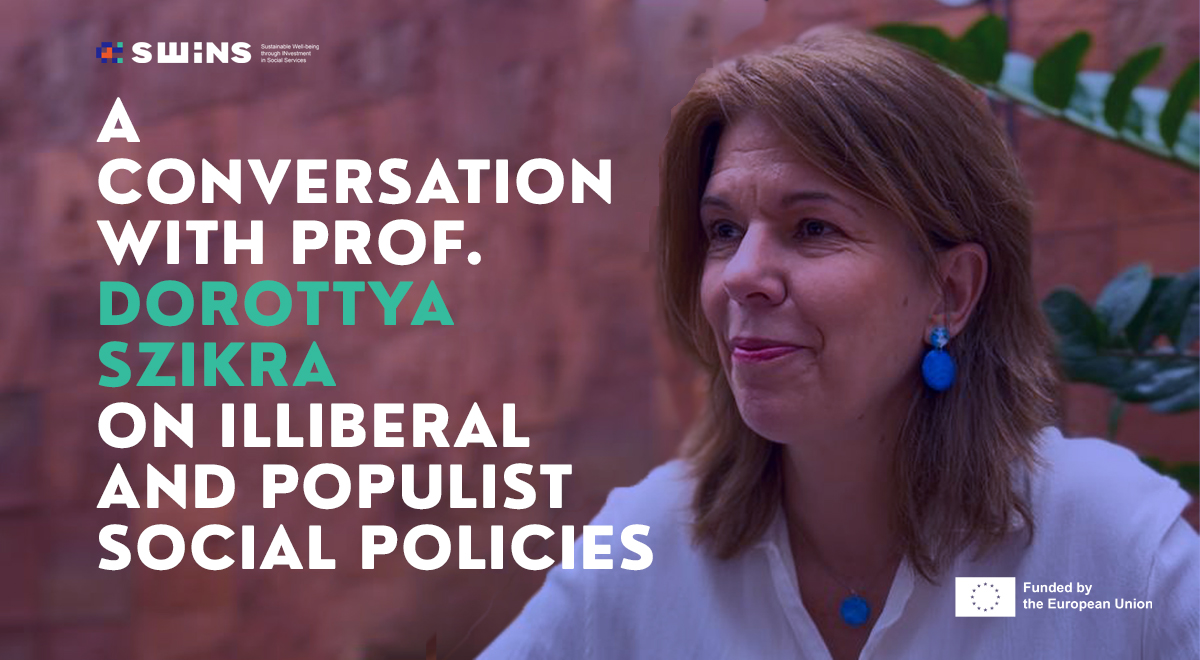
In Budapest, we met with Prof. Dorottya Szikra, Research Professor at the Centre for Social Sciences. We invited her to understand better her research on illiberal and populist social policymaking in Hungary and Turkey, and the role of social policy in processes of democratic backsliding.
Do you think that Social policies are loosing ground in today debate, given the dual pressure of rising investment in competitiveness, including military spending and the increasing prominence of welfare chauvinism?
That’s a very good question. When this question was asked from me one and a half years ago by a journalist, I said, “No, no, no. This is this is just the usual worry of of social policy people or or politicians.” But now I think the danger is really serious also on the level of the EU. to cut funds for social inclusion and also on the level of the individual member states because of the pressure from militarisation and also other dangers that make all budgets absolutely fragile and economies also absolutely fragile.
In your work you analyse illiberal and populist social policies. How can we distinguish in practice between generally inclusive policies and those used for political control and also what kind of evidence of indicator would we need to use?
I I’ve been thinking about this a lot because what we have seen especially in our work with my Turkish colleague Kerem Gabriel Öktem, we have a paper comparing Turkish and Hungarian social policies where we made a timeline where we marked the important political event like elections and and the important social policy measures to see whether they really like driven by the political event, like right before the political event if there would be like a huge increase of pensions. What we have found and what is I believe a difference between populist and non-populist social policy making or welfare states is that these cases, certainly for Turkey and Hungary are under Erdogan and Orban, there were very clearly politically driven social policy decisions that preceded the elections especially in Turkey for instance providing special payments for pensioners right before the elections and also social policy decisions very closely followed the electoral cycle.
So and these changes were not incremental small changes but often quite paradigmatic.
Can bad politics make good policies?
Well, because in authoritarian states, the incumbent is actually the one who is making the decisions because they don’t really listen to experts. This would lead to quick decision making, often quite brave policies that liberal democracies would never ever execute because of the constraints that they have. And sometimes this plays out as quite good policy so to say. But at the same time, because of the lack of reconciliation and lack of expertise involve it can often lead to policy failure which we see all the time in these countries like that. There is a a suddenly implemented huge paradigmatic reform that then needs a lot of correction. later on. and also quite often huge waste of money.
Read more on Prof. Szikra work:
An illiberal welfare state emerging? Welfare efforts and trajectories under democratic backsliding in Hungary and Turkey – Dorottya Szikra, Kerem Gabriel Öktem, Department of Gender Studies, Centre for Social Sciences Central European University.
The interview is lead by Arianna Vivoli, researcher at ARCO – Fondazione PIN and has been possible with the help of all partners from TARKI Social Research Institute.